

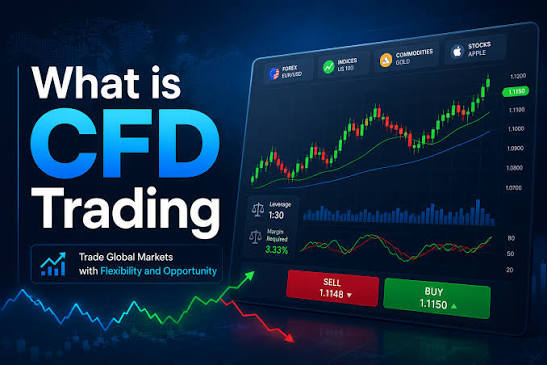
Leverage is one of the most important concepts traders encounter in financial markets. In forex stock trading, it allows traders to control larger positions by committing a smaller amount of capital as margin. This can increase market exposure and make capital usage more flexible, but it can also magnify losses when prices move against a position.
Understanding how leverage works is therefore essential before entering currency or stock CFD trades. By learning about margin, position size, market volatility, and risk controls, traders can approach leveraged trading with greater awareness and discipline.
Understanding Leverage in Simple Terms
Leverage increases market exposure without requiring the full value of a position upfront. A ratio of 1:50 means a trader can control a position worth 50 times the margin allocated to that trade.
For example, if a position requires $1,000 in margin with 1:50 leverage, the trader may control exposure worth $50,000. Margin is not the same as potential loss. A small movement against the position can produce a significant loss when exposure is large.
How Leverage Works in Forex
Currency markets often involve small price movements, which is one reason leverage is widely associated with forex trading. Instead of committing the full value of a currency position, a trader provides a percentage as margin.
Suppose a trader opens a EUR/USD position with $1,000 of margin and uses 1:50 leverage. The exposure would be $50,000. If the currency pair moves favourably, the return on margin can increase. If it moves in the opposite direction, the loss can also accumulate faster.
This makes position sizing important. Traders should consider position value, stop-loss distance, expected volatility, and the amount they are prepared to risk before selecting leverage.
Leverage in Stock CFD Trading
Stock CFDs allow traders to speculate on price changes without directly owning the underlying shares. Leverage can allow larger CFD positions using a smaller amount of margin.
For example, imagine a stock CFD position with $2,000 of exposure and 1:10 leverage. The required margin could be $200, subject to the provider’s rules. If the stock changes by 5%, the position changes by $100 before applicable costs. The percentage movement applies to the full exposure, while the return or loss relative to the margin can be much larger.
Individual shares can experience sharp moves after earnings announcements, economic releases, company news, or unexpected events. Leveraged stock CFDs therefore require careful risk planning.
Why Higher Leverage Is Not Always Better
A higher leverage ratio may reduce the margin required to establish a position. However, having access to more leverage does not mean a trader must use the maximum available amount.
Higher exposure magnifies both gains and losses. It may also reduce the adverse movement a position can withstand before additional margin is required or the position is closed under applicable rules.
A disciplined trader can choose lower effective exposure even when an account offers a high maximum ratio. The question is not simply how much leverage is available, but how much exposure suits the strategy and risk tolerance.
The Relationship Between Margin and Leverage
Margin and leverage are closely connected. Margin represents funds required to open and maintain a leveraged position, while leverage describes the relationship between position size and supporting margin.
If leverage increases, the margin requirement for a given position generally decreases. For example, 1:20 requires more margin than 1:100 for the same exposure. This can improve capital efficiency, but it does not remove market risk.
Margin requirements can vary according to the instrument, account conditions, volatility, and regulatory requirements. Checking product specifications before entering a position can help avoid unexpected requirements.
Using Stop-Loss Orders With Leverage
Risk controls are particularly important when trading leveraged products. A stop-loss order can help define the price level where a trader wants to exit if the market moves unfavourably.
However, a stop-loss does not guarantee that the exact requested price will always be achieved. During fast-moving or less liquid conditions, execution can differ from the intended level. Traders should therefore consider volatility and possible gaps when setting protective orders.
A sensible approach is to determine acceptable monetary risk first and then calculate position size. Leverage should support that calculation rather than determine it.
Leverage and Trading Costs
Leverage can influence the cost structure because a larger position creates greater exposure to spreads and, where applicable, overnight financing or swap charges. These expenses can become more meaningful when positions remain open for extended periods.
Before comparing the best forex websites, traders can examine spreads, commissions, margin requirements, overnight charges, available instruments, execution conditions, platform features, and regulatory information. Looking only at a headline leverage figure can give an incomplete picture of trading conditions.
Building a Responsible Leverage Strategy
A responsible approach starts with risk rather than potential returns. Traders can establish a maximum amount they are willing to lose, calculate a suitable position size, place protective orders where appropriate, and keep enough available margin to handle market fluctuations.
It is also useful to test a strategy on a demo account before applying it to live capital. A demo environment can help traders understand how margin, position size, price movement, and platform calculations interact without immediately exposing real funds.
Final Thoughts
Leverage can make forex stock trading more capital-efficient by allowing traders to access larger market exposure with a smaller margin requirement. However, the same mechanism magnifies losses when prices move against a position. Understanding margin, position sizing, volatility, trading costs, and protective controls can help traders use leverage deliberately rather than choosing the highest available ratio. The objective should be controlled exposure and informed decision-making.
For traders seeking flexible access to global financial markets, AngelSky provides multi-asset trading through MetaTrader 5, with access to Forex, shares, indices, commodities, ETFs, crypto and futures CFDs. Its services include multiple account types, demo trading, real-time market tools, competitive spreads, fast execution, and 24/7 support. Traders can explore global instruments through its trading infrastructure while using platform tools designed for analysis, monitoring, and risk management, with flexible access across desktop and mobile.
