

Triangles are fundamental shapes in geometry, and calculating their properties is a common task encountered in mathematics and various real-world applications. One crucial aspect of a triangle is its height, which is essential for determining its area and understanding its spatial characteristics. Whether you’re a student learning geometry or someone needing to solve practical problems, knowing how to find the height of a triangle is a valuable skill. In this guide, we’ll explore different methods to find the height of a triangle.
Understanding Triangle Height:
Before delving into the methods, let’s clarify what we mean by the height of a triangle. The height (or altitude) of a triangle is the perpendicular distance from any vertex to the line containing the opposite side. It forms a right angle with the base or the side it’s measured from.
Method 1: Using the Area Formula:
One of the most straightforward methods to find the height of a triangle is by using its area formula. The area of a triangle can be calculated using the formula:
Area=12×base×heightArea=21×base×height
Rearranging this formula, we can solve for the height:
Height=2×AreabaseHeight=base2×Area
Where:
- Area is the known area of the triangle.
- Base is the length of the base of the triangle.
By substituting the known values for area and base, you can easily find the height of the triangle.
Method 2: Using Trigonometry:
Another approach involves using trigonometric functions, particularly if you know the lengths of two sides of the triangle and an angle between them. The sine function can be helpful in finding the height of the triangle.
Consider a right-angled triangle where one angle is known, and two sides adjacent to the angle are given. Let’s call this angle �θ. If �a and �b are the lengths of the sides adjacent to the angle �θ, and ℎh is the height of the triangle, then:
sin(�)=OppositeHypotenuse=ℎ�sin(θ)=HypotenuseOpposite=ah
From this equation, you can solve for the height (ℎh):
ℎ=�×sin(�)h=a×sin(θ)
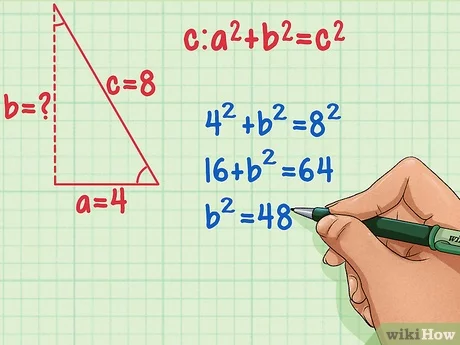
Method 3: Using the Pythagorean Theorem:
If you know the lengths of all three sides of a triangle, you can use the Pythagorean theorem to find the height. Consider a triangle with sides �a, �b, and �c, where �c is the base. Let ℎh be the height from the vertex opposite the base to the base. According to the Pythagorean theorem:
�2=ℎ2+�2a2=h2+x2
Where �x is the length from the base of the triangle to the foot of the height. Solving for ℎh, we get:
ℎ=�2−�2h=a2−x2
By substituting the known values for �a, �b, and �c, you can find the height of the triangle.
Conclusion:
Finding the height of a triangle is essential for various mathematical and real-world applications. Whether you use the triangle’s area formula, trigonometry, or the Pythagorean theorem, understanding these methods equips you with the necessary tools to solve problems involving triangles. By following the step-by-step approaches outlined in this guide, you can confidently determine the height of any triangle you encounter.
