


Information has now become the heart of organizations. While big data is the foundation, it’s more than just raw data. To gain a better understanding and make the right decisions based on data, artificial intelligence systems are being adopted. Today, AI amazes the world of data analysis by performing elaborate tasks, revealing trends that are not easy to identify, and forecasting further trends. This blog post will encompass various aspects of AI for data analysis, including its applications and tools marking its future. Let’s begin with the difference between traditional methods used in data analysis and modern approaches.
Traditional Methods vs. Modern Approaches Of Data Analysis
Traditional approaches to data analysis include lengthy processes like data sorting using Excel sheets and raw statistics techniques that are very sensitive to errors. These techniques are often used to work with quantitative data, and data analysis does not require the use of innovative approaches. Some of the above methods work fine for a small amount of data but fail to scale up to address the volume, variety, and velocity of data in modern big data applications.
In contrast, modern data analysis practices use technologies such as artificial intelligence, machine learning, and big data tools. Python for Data Science methods can work with large volumes of unprocessed data, facilitating greater, quicker rates of analysis and estimation. The transition from traditional techniques enables organizations to leverage their big data, leading to innovations and improved performance. But how can these modern approaches help in data analysis? Let’s understand!
The Role of AI for Data Analysis
The Role of AI for Data Analysis basically comes down to what artificial intelligence brings to data interpretation and use. AI reviews data and provides further analysis, including data computations, pattern recognition, and predictive opportunities that it is improbable for an individual to undertake on his or her own.
AI’s role in data analysis includes:
Automating Data Processing: AI takes care of repetitive tasks in the data quality refinement and data preparation, leaving the analysis phase less susceptible to human input errors.
Advanced Pattern Recognition: AI particularly performs the task of identifying intricate patterns within data, thus making it possible to uncover various trends, anomalous situations or relationships that may not be noticeable under conventional analysis methods.
Predictive Analytics: With the incorporation of AI in past data to make future projections allows organizations to forecast change, standardize strategies, and stay one step ahead.
Real-time Analysis: Compared to a human analyst, proactive AI systems can rapidly analyze data and provide answers and insights within a few moments.
Enhanced Decision-making: The utilization of AI in data analysis helps organizations make more accurate and faster decisions, leading to improved confidence in their functions and better results.
Therefore, AI boosts the power of data analysis and, at the same time, provides a more potent tool that is more effective and valuable to gain an edge and seize opportunities in the market for any business organization.
AI Tools in Data Analysis
AI tools in data analysis are beneficial to many as they help one make the best use of artificial intelligence while analyzing data. These tools simplify data analysis and increase the effectiveness of pattern matching, and offer prognostication capabilities to facilitate faster and more appropriate decision-making. Essential AI tools include:
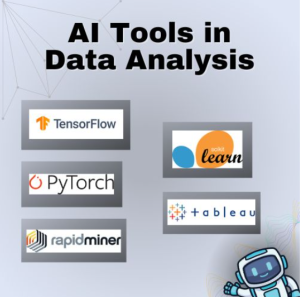
TensorFlow: It is an open-source framework primarily used for machine learning and developing AI models.
PyTorch: A robust deep learning framework widely used for its versatility and simplicity.
Scikit-learn: An open-source library for data extraction and data analysis using Python for machine learning and statistical analysis.
RapidMiner: An analytics platform supporting data discovery, analysis, and advanced analytics applications.
Tableau: This is not strictly AI software, but It currently incorporates AI elements for data visualization and analytical discovery.
With the help of these tools, data analysts and companies may fully unlock the potential of artificial intelligence and turn fabulous data into fantastic insights. Now let’s explore how these tools can be applied in data analysis.
Applications of AI for Data Analysis
Applications of AI for Data Analysis are revolutionizing how organizations are dealing with the data and how they make use of it in every sector. Some key applications include:
Predictive Analytics: Analyses of previous data by AI models make future market or industry trends possible to foresee and lessen the impacts on a business.
Fraud Detection: AI analyzes real-time monitoring of financial transactions and historical data to conclusively detect fraudulent patterns or anomalies.
Customer Insights: The use of AI involves assessing customer trends and using this information to deliver better results, enhancing customer experience.
Sentiment Analysis: AI for data analysis can analyze posts, reviews, and feedback to reflect the views of the masses, thereby assisting brands in responding to consumer opinions.
Operational Optimization: AI examines the information flow in supply chains, manufacturing, and logistics to identify ways to minimize expenses and enhance productivity.
These applications clearly show the usefulness of AI technology in converting raw data into valuable and meaningful information. With the expertise of artificial intelligence developers, these applications can be effectively implemented and optimized. What do you think how long AI can be helpful for data analysis?
The future of AI in data analysis
AI is predicted to play an even more significant role in the future of data analytics for businesses by radically altering the ways data is collected, processed, analyzed, and utilized for decision-making processes. AI for data analysis will improve the accuracy of predictions, eliminate the time issues connected with data processing and make analytics more accessible and more user-friendly, thus facilitating better insights and valuable outcomes.
Automated Data Processing: The use of AI will significantly decrease the workload when it comes to data collection and preprocessing steps.
Advanced Predictive Analytics: Technological and AI models will generate real-time predictions helping businesses predict trends and respond proactively.
Natural Language Processing (NLP): AI will enable users to engage with data via conversational queries and integrate analytics into regular business processes.
AI-Driven Data Visualization: Self-driving dashboards will then be able to deliver personalized analytical recommendations.
Ethical and Explainable AI: There is likely an increased emphasis on the use of ethics and reducing bias through the application of AI techniques.
Integration with IoT and Big Data: Based on the data collected by IoT devices, AI will optimize the organizational flow and provide a real-time analysis of collected data.
Conclusion
The integration of AI with data analysis is not only about the improvement of specific processes but also about a revolution in how companies utilize and operate data. The future of AI for data analysis is inherently positive as the technology advances. It gives many organizations the tools needed to understand what is happening on a higher level and may make decisions much faster and more accurately than before. It is also essential for businesses to work with AI consulting services providers to ensure they can bring the power of AI to deliver innovation in data analytics for competitive advantage.
