


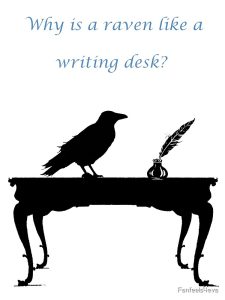
One of the most famous literary riddles in history comes from Alice’s Adventures in Wonderland: “Why is a raven like a writing desk?“ This question, posed by the Mad Hatter during the tea party scene, has puzzled readers for over a century. Unlike typical riddles with clear solutions, this one was never meant to have an answer—at least, not initially. However, over time, interpretations, wordplay, and even a response from Lewis Carroll himself have kept the debate alive.
Many have speculated about the connection between a raven and a writing desk, linking the riddle to themes of nonsense, literature, and even famous figures like Edgar Allan Poe. But does the riddle have a real answer, or was it simply a playful trick by Carroll? Let’s dive into the origins, theories, and wordplay surrounding this puzzling question.
The Origin of the Riddle in Alice Adventures in Wonderland
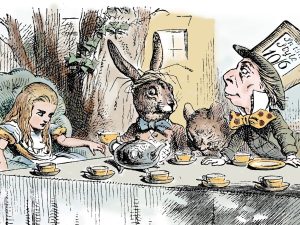
The riddle first appeared in 1865 in Carroll’s novel Alice’s Adventures in Wonderland, during the Mad Hatter’s Tea Party. The Mad Hatter asks Alice, “Why is a raven like a writing desk?” but, as the conversation continues, he admits, “I haven’t the slightest idea!” This makes it clear that the question was meant as pure nonsense, fitting with the whimsical and illogical world of Wonderland.
Carroll, known for his love of puzzles and wordplay, likely included the riddle to entertain rather than to be solved. Many early readers, however, did not realize it was a joke and took it as a genuine riddle, leading to decades of speculation. As a result, people began attempting to find real answers, even though Carroll never intended one.
Lewis Carroll and His Playful Use of Logic
Lewis Carroll (real name Charles Lutwidge Dodgson) was not only a writer but also a mathematician, logician, and wordplay enthusiast. His works often played with language, logic, and paradoxes, and his inclusion of the unanswerable riddle was a reflection of his love for intellectual games.
He enjoyed nonsense literature, where words and meanings could be twisted, reversed, or made meaningless altogether. The raven and writing desk riddle is a perfect example of this: it sounds like it should have an answer, yet none was provided, making it an unsolvable puzzle by design.
However, due to public demand, Carroll eventually offered an answer, but even that was filled with wordplay rather than logical reasoning.
Is There a Real Answer to the Riddle?
For years, readers, literary scholars, and puzzle enthusiasts have attempted to come up with answers to the riddle. Some of the most common suggestions include:
- Both have quills (feathers for the raven, pens for writing desks).
- Both can carry words (a raven can mimic speech, a writing desk holds written words).
- Poe wrote on both (Edgar Allan Poe was famous for his raven poem and his writing desk).
Despite these clever responses, they were all created after the fact, meaning they were not Carroll’s original intention. However, Carroll himself did eventually propose an answer in the 1897 edition of Alice’s Adventures in Wonderland.
Lewis Carroll’s Own Answer to the Riddle
In the 1897 revision of his novel, Carroll included a response:
“Because it can produce a few notes, though they are very flat; and it is never put with the wrong end in front!”
Interestingly, in early prints of this revision, the word “never” was spelled as “nevar”, which is “raven” spelled backward. This was likely a deliberate pun, but later editions corrected the spelling to “never,” removing the clever wordplay.
Even with this answer, Carroll himself admitted it wasn’t meant to be taken seriously. He later wrote:
“The riddle, as originally invented, had no answer at all.”
Thus, even the creator of the riddle confirmed it was meant as pure nonsense, yet his proposed answer continues to be widely referenced.
Famous Interpretations of Why a Raven Is Like a Writing Desk
Over the years, many have attempted to rationalize the riddle with their own interpretations. Some of the most famous ones include:
- Poe Connection – Edgar Allan Poe, known for The Raven, frequently used a writing desk.
- Quills and Writing – Both a raven and a writing desk are associated with quills (raven’s feathers and old-fashioned ink pens).
- Mimicry – A raven can “speak” by mimicking sounds, and a writing desk holds words that “speak” to readers.
Even though these explanations are creative and logical, they were all developed after Carroll wrote the riddle.
Edgar Allan Poe’s Connection to the Riddle
One of the most famous theories linking the riddle to literary history is its connection to Edgar Allan Poe. Poe’s poem The Raven (published in 1845) is one of the most iconic poems in American literature. Because of this, some believe Carroll subtly referenced Poe with the riddle, suggesting that a raven and a writing desk are connected through literature and poetry.
However, there is no historical evidence that Carroll had Poe in mind when writing the riddle. The connection is purely speculative, but it remains one of the most popular explanations today.
The Role of Wordplay and Nonsense in Carroll’s Writing
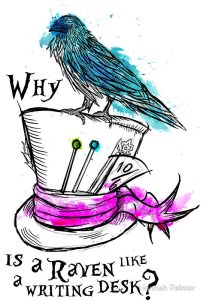
Carroll’s works are filled with puns, paradoxes, and absurdity. Many of the jokes and riddles in Alice’s Adventures in Wonderland rely on twisting language, reversing meanings, or creating impossible logic.
- The riddle fits perfectly into this style—it appears meaningful but is intentionally meaningless.
- Carroll later adding an answer only added to the humor, as it made the riddle seem even more absurd.
- The “nevar” spelling joke is another example of his love for reversible words and hidden jokes.
The raven and writing desk riddle is a great example of how Carroll’s nonsense literature challenges logic while remaining playful and fun.
The Influence of the Riddle on Literature and Pop Culture
Lewis Carroll’s famous riddle, “Why is a raven like a writing desk?”, has left a lasting mark on literature and pop culture. While it was originally meant as a nonsensical question, many authors, filmmakers, and artists have used it to explore deeper themes of logic, absurdity, and creativity.
Influence on Literature
- Many authors have referenced the riddle in their works, using it to symbolize mystery and intellectual curiosity.
- In Neil Gaiman’s The Sandman, the character Matthew, a talking raven, hints at the riddle’s literary significance.
- Terry Pratchett, in Discworld, plays with similar surreal humor, embracing Carroll’s whimsical style.
Presence in Popular Culture
- The riddle appears in movies, TV shows, and music, often as a symbol of nonsense or unsolvable mysteries.
- Tim Burton’s Alice in Wonderland (2010) revisits the riddle, giving it a new interpretation through the Mad Hatter’s cryptic musings.
- Bands and musicians have also referenced it in lyrics, emphasizing its timeless intrigue.
This simple yet puzzling question continues to inspire creativity, proving that sometimes, a riddle doesn’t need a clear answer to leave an impact.
Alternative Answers Proposed Over Time
Since Carroll never intended a real answer, many writers and thinkers have attempted to solve the riddle in creative ways. Some of these answers are playful, while others delve into linguistic and philosophical interpretations.
Carroll’s Own Answer
In the 1897 edition of Alice’s Adventures in Wonderland, Carroll proposed:
“Because it can produce a few notes, though they are very flat; and it is never put with the wrong end in front!”
- Some early editions spelled “never” as “nevar”, which is “raven” spelled backward.
- This hints at Carroll’s love for wordplay and paradoxes.
Other Popular Interpretations
- “Because Poe wrote on both.” – A reference to Edgar Allan Poe, famous for The Raven.
- “Because both have inky quills.” – A connection between a raven’s feathers and the quill pens used for writing.
- “Because one flies through the air, and the other through ideas.” – A metaphorical take on imagination and expression.
The variety of responses shows how the riddle has grown beyond its original context, inviting endless creativity and speculation.
The Riddle’s Impact on Philosophy and Absurdism
Carroll’s riddle is not just a literary curiosity—it has become a symbol of absurdist philosophy. Many thinkers have used it to explore the nature of meaning, logic, and the limits of language.
Absurdism and the Limits of Meaning
- The riddle embodies the idea that not everything needs an answer, aligning with absurdist thinkers like Albert Camus.
- It challenges the human tendency to seek meaning where none exists.
- Similar to Zen koans, it forces us to confront the limits of logic and reason.
Surrealism and Nonsense in Art
- The surrealist movement, inspired by dreamlike logic, often embraces paradoxes like Carroll’s riddle.
- Salvador Dalí and René Magritte incorporated nonsensical imagery, much like Carroll did with words.
- The riddle highlights how absurdity can be a form of deep intellectual exploration.
In this way, “Why is a raven like a writing desk?” is more than just a playful question—it’s a thought-provoking puzzle that challenges how we perceive and interpret the world.
Frequently Asked Questions About Why Is a Raven Like a Writing Desk
Did Lewis Carroll ever provide a real answer?
Yes, in 1897, Carroll suggested: “Because it can produce a few notes, though they are very flat; and it is never put with the wrong end in front!”
Is the riddle supposed to have an answer?
Originally, no. It was meant as pure nonsense, fitting the absurd and whimsical world of Alice in Wonderland.
Why do people associate the riddle with Edgar Allan Poe?
Poe wrote The Raven, and a popular answer to the riddle is “Because Poe wrote on both”—a reference to writing on paper and writing The Raven.
Has the riddle appeared in pop culture?
Yes! It has been referenced in movies, TV shows, books, and music, often as a symbol of mystery and absurdity.
What does the riddle say about logic and meaning?
It challenges the idea that every question must have a logical answer, making it a perfect example of absurdism and playful language.
Conclusion on Why Is a Raven Like a Writing Desk
Lewis Carroll’s famous riddle has remained one of the most enduring mysteries in literature. Originally intended as pure nonsense, it has evolved into a symbol of creativity, philosophy, and playful logic. Over the years, readers and scholars have proposed countless interpretations, showing that the riddle’s true magic lies in its ability to spark imagination and debate.
Whether viewed as a literary joke, a philosophical puzzle, or a challenge to logic, “Why is a raven like a writing desk?” proves that sometimes, the most intriguing questions are the ones that don’t have a definitive answer.
